

Does Taiwan experience all four seasons like many other regions around the world? This article aims to shed light on this topic and debunk the myth surrounding Taiwan’s seasonal changes.

Understanding Taiwan’s Climate
Taiwan’s climate is heavily influenced by its geographical location, which places it in a subtropical climate zone. As a result, its weather patterns differ significantly from those of temperate regions that experience distinct and well-defined four seasons. Instead, Taiwan’s climate can be best described as having two main seasons: a wet season and a dry season.
The Wet Season (Late Spring to Early Autumn)
From late spring to early autumn (approximately May to September), Taiwan enters its wet season. During this period, the island experiences higher temperatures and increased rainfall, often accompanied by typhoons. These weather conditions contribute to the lush landscapes that Taiwan is known for, as its mountains and forests flourish under the abundant moisture.
The Dry Season (Late Autumn to Early Spring)
Conversely, the dry season occurs from late autumn to early spring (around October to April). During this time, the amount of rainfall decreases significantly, and the temperatures become milder. This period is generally considered the best time to visit Taiwan, as the weather is more comfortable for outdoor activities and exploration. During that period, the country’s highest peaks can occasionally experience some snowfall, it is also the best season to experience the country’s hot springs.
The Absence of Extreme Seasonal Changes
While Taiwan does experience these two main seasons, it is important to note that the transitions between them are not as pronounced as in regions with true four seasons. In temperate climates, such as those found in North America or Europe, the changes between spring, summer, autumn, and winter are stark and unmistakable. In contrast, Taiwan’s climate remains relatively consistent throughout the year, with more gradual shifts in temperature and precipitation.
Subtropical Fluctuations
Taiwan’s subtropical climate also means that even within its two main seasons, there can be noticeable fluctuations in weather. For instance, during the wet season, there can be periods of dry weather, and the dry season might witness occasional rainfall. This can lead to a sense of unpredictability that is not commonly associated with the predictable patterns of true four-season climates.
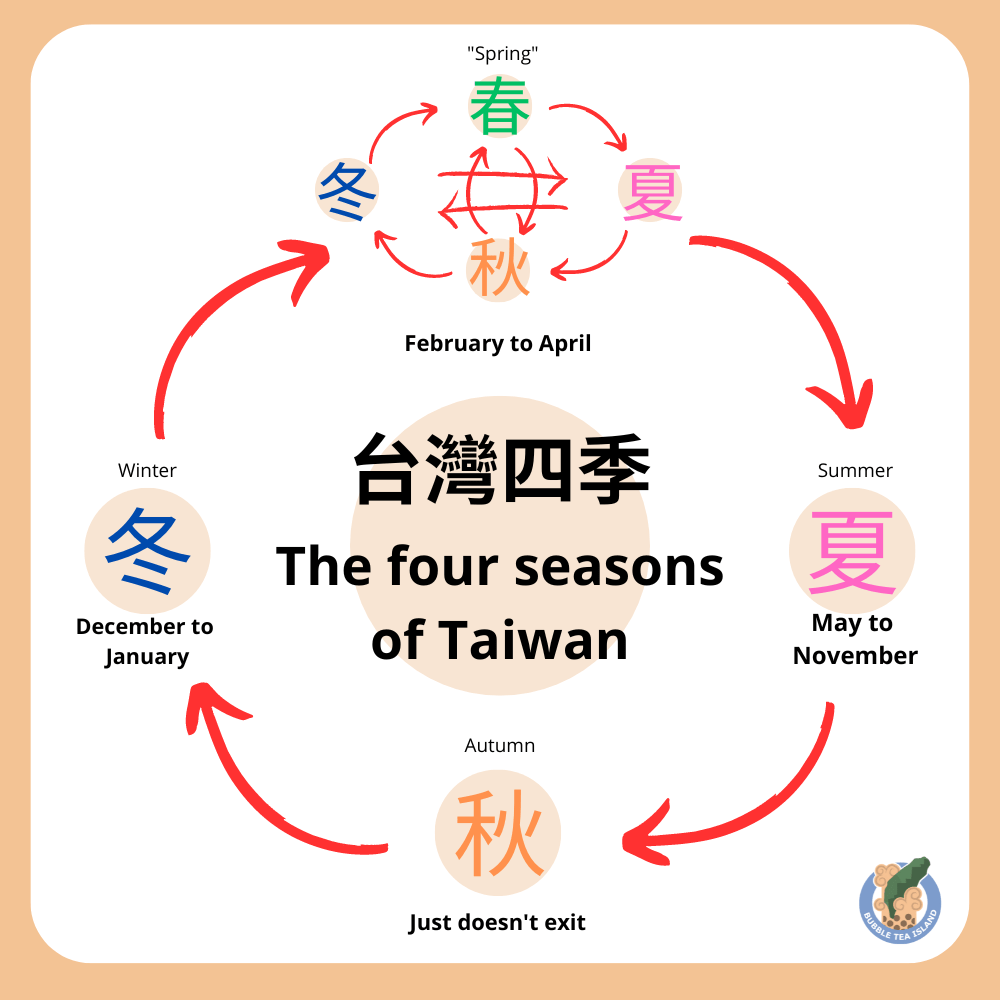
A popular internet meme describes the erratic nature of Taiwanese weather, especially during the period from February to April, where it appears as though the climate can transition from summer to winter and from autumn to spring within a matter of days.

While Taiwan does experience two main seasons—wet and dry—its climate differs significantly from the traditional four-season model. The island’s subtropical climate results in more subtle and gradual changes in temperature and precipitation, blurring the distinct boundaries between spring, summer, autumn, and winter. This unique climate contributes to Taiwan’s lush landscapes and vibrant ecosystems, making it a fascinating destination for travelers seeking a different kind of seasonal experience. So, while Taiwan may not have the classic four seasons, its climate diversity remains a significant part of its allure.
 Bubble Tea Island