

The Chinese language is renowned for its complexity and rich linguistic nuances, which often pose challenges for learners. Two words that often perplex Chinese learners are 少 (ㄕㄠˇ – shǎo) and 小 (ㄒㄧㄠˇ – xiǎo). These two characters may appear similar at first glance, as they both relate to the concept of “small” or “few.” However, a closer examination reveals subtle differences in their meanings, usage, and contexts. Their usage can be summed up simply:
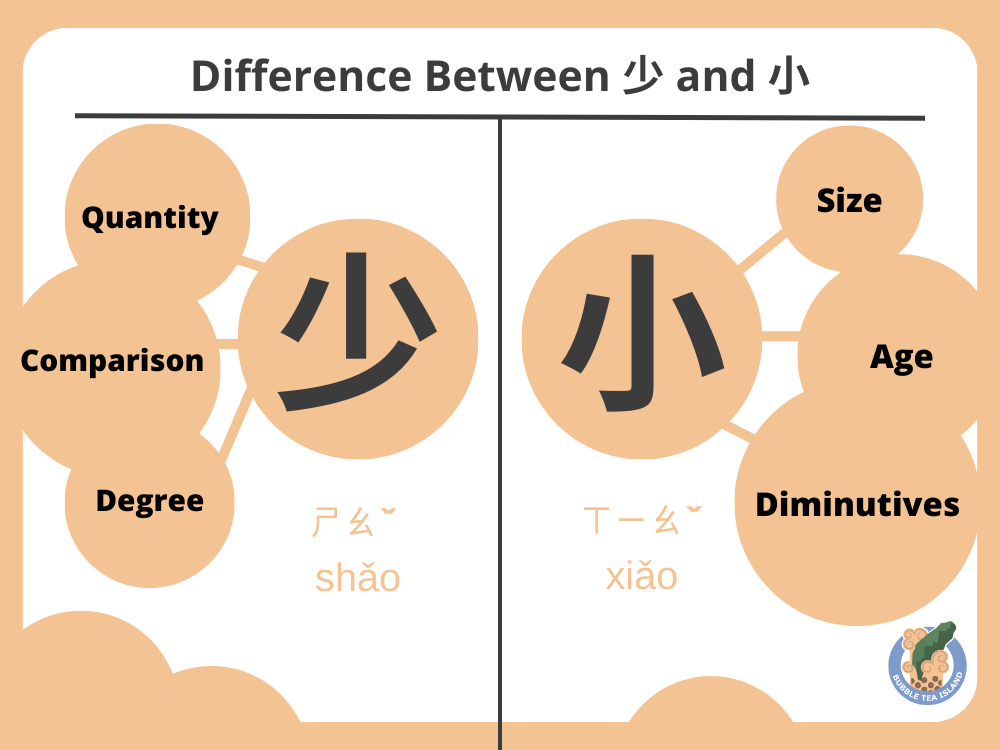
- 少 is used to describe a small quantity or few.
- 小 is used to describe the small size of something.
少 (ㄕㄠˇ – shǎo) – Few, Less
The character 少 primarily conveys the idea of “few” or “less.” It is used to indicate a small quantity, scarcity, or insufficiency. Here are some key points to understand about 少:
Quantity
少 is used to quantify something, indicating that there is a limited amount or a shortage. For example:
- 他有很少朋友(ㄊㄚ ㄧㄡˇ ㄏㄣˇ ㄕㄠˇ ㄆㄥˊ ㄧㄡˇ) – “He has very few friends.”
- 這家餐廳的菜單上有很少的素食選項 (ㄓㄜˋ ㄐㄧㄚ ㄘㄢ ㄊㄧㄥ ㄉㄜ˙ ㄘㄞˋ ㄉㄢ ㄕㄤˋ ㄧㄡˇ ㄏㄣˇ ㄕㄠˇ ㄉㄜ˙ ㄙㄨˋ ㄕˊ ㄒㄩㄢˇ ㄒㄧㄤˋ) – “There are very few vegetarian options on this restaurant’s menu.”
Comparison
少 is often used in comparisons to denote a smaller quantity in contrast to something else. For example:
- 這個城市的交通費用比那個城市少 (ㄓㄜˋ ㄍㄜˋ ㄔㄥˊ ㄕˋ ㄉㄜ˙ ㄐㄧㄠ ㄊㄨㄥ ㄈㄟˋ ㄩㄥˋ ㄅㄧˇ ㄋㄚˋ ㄍㄜˋ ㄔㄥˊ ㄕˋ ㄕㄠˇ) – “The transportation costs in this city are less than in that city.”
Degree
少 can also be used to describe the degree of a quality, indicating a lesser degree. For example:
- 他的工作能力比他的同事少 (ㄊㄚ ㄉㄜ˙ ㄍㄨㄥ ㄗㄨㄛˋ ㄋㄥˊ ㄌㄧˋ ㄅㄧˇ ㄊㄚ ㄉㄜ˙ ㄊㄨㄥˊ ㄕˋ ㄕㄠˇ) – “His work ability is less than that of his colleagues.”
小 (ㄒㄧㄠˇ – xiǎo) – Small, Little
The character 小 generally means “small” or “little” and is used to describe the physical size, age, or scale of something. Here are some important aspects to know about 小:
Size
小 is often used to describe the physical size of objects, people, or animals. For example:
- 這隻狗很小 (ㄓㄜˋ ㄓ ㄍㄡˇ ㄏㄣˇ ㄒㄧㄠˇ) – “This dog is very small.”
- 這個包包很小 (ㄓㄜˋ ㄍㄜˋ ㄅㄠ ㄅㄠ ㄏㄣˇ ㄒㄧㄠˇ) – “This bag is very small.”
Age
小 can be used to indicate a person’s young age, especially when discussing children or family members. For example:
- 我有一個小兒子 (ㄨㄛˇ ㄧㄡˇ ㄧ ㄍㄜˋ ㄒㄧㄠˇ ㄦˊ ㄗˇ) – “I have a young son.”
Diminutives
小 can also be used as a diminutive suffix attached to a person’s name or title to express familiarity, affection, or informality. For instance:
- 小明 (ㄒㄧㄠˇ ㄇㄧㄥˊ) – A common given name, meaning “Little Ming.”
While both 少 and 小 may seem similar, their usage in Chinese is distinct. 少 is primarily concerned with quantity and scarcity, indicating a smaller amount or a deficiency. On the other hand, 小 is more focused on the physical size, age, or scale of something, describing things as “small” or “little.”
Understanding the nuances between these two characters is crucial for effective communication in Chinese, as using them interchangeably can lead to misunderstandings. So, whether you’re discussing the size of objects or the scarcity of resources, knowing when to use 少 or 小 will help you express yourself accurately and fluently in Mandarin Chinese.
Join our Substack “Mandarin Zest“, where we regularly share intermediate to advanced Chinese learning content. Make sure to subscribe!
 Bubble Tea Island