

From the bustling city streets of Taipei to the tranquil landscapes of rural Chiayi, mastering the intricacies of directional language is essential. This comprehensive guide aims to delve deep into the subtleties of expressing movement, inquiring and providing directions, understanding cardinal and intercardinal directions, incorporating positional words and building a vocabulary for common places in Chinese.

How to Ask for Directions in Chinese
In unfamiliar surroundings, the ability to seek guidance politely is a valuable skill. Remember that when asking a question to someone you don’t know you should always start your question with “請問” (ㄑㄧㄥˇ ㄨㄣˋ – qǐngwèn).
Simple Question Patterns
……在哪?(…… ㄗㄞˋ ㄋㄚˇ ? – …zài nǎ?)
Where is …?
去……怎麼走?(ㄑㄩˋ …… ㄗㄣˇ ㄇㄜ˙ ㄗㄡˇ ? – qù … zěnme zǒu?)
How do you go to …?
……離這裡有多遠?(…… ㄌㄧˊ ㄓㄜˋ ㄌㄧˇ ㄧㄡˇ ㄉㄨㄛ ㄩㄢˇ ? – …lí zhèr yǒu duō yuǎn?)
How far is …?
How to Give Directions in Chinese
Providing clear and concise directions is equally important. You can use this very simple sentence structure:
[Destination] 在 [reference] + [Position]
For example:
圖書館在銀行的左邊。
ㄊㄨˊ ㄕㄨ ㄍㄨㄢˇ ㄗㄞˋ ㄧㄣˊ ㄒㄧㄥˊ ㄉㄜ˙ ㄗㄨㄛˇ ㄅㄧㄢ。
Túshū guǎn zài yínháng de zuǒbiān.
The library is to the left of the bank.
Movement Verbs
Exploring directions in conversation naturally entails discussing various movements. To begin our exploration, let’s delve into common movement verbs in Chinese.
| Chinese | Bopomofo | Pinyin | English |
|---|---|---|---|
| 走 | ㄗㄡˇ | zǒu | to walk |
| 跑 | ㄆㄠˇ | pǎo | to run |
| 開車 | ㄎㄞ ㄔㄜ | kāichē | to drive |
| 騎車 | ㄑㄧˊ ㄔㄜ | qíchē | to ride a bike |
| 游泳 | ㄧㄡˊ ㄩㄥˇ | yóuyǒng | to swim |
| 飛行 | ㄈㄟ ㄒㄧㄥˊ | fēixíng | to fly |
| 航行 | ㄏㄤˊ ㄒㄧㄥˊ | hángxíng | to navigate/sail |
| 跳舞 | ㄊㄧㄠˋ ㄨˇ | tiàowǔ | to dance |
Movement Phrases
Here are some more movement phrases that you can use:
| Chinese | Bopomofo | Pinyin | English |
|---|---|---|---|
| 往前走 | ㄨㄤˇ ㄑㄧㄢˊ ㄗㄡˇ | wǎng qián zǒu | go straight |
| 向 … 轉 | ㄒㄧㄤˋ … ㄓㄨㄢˇ | xiàng … zhuǎn | turn … |
| 從 … 到 … | ㄘㄨㄥˊ … ㄉㄠˋ … | cóng … dào … | from … to … |
| 過 | ㄍㄨㄛˋ | guò | cross |
| 經過 | ㄐㄧㄥ ㄍㄨㄛˋ | jīngguò | pass |
Cardinal Directions in Chinese
Mastering cardinal directions is foundational for spatial orientation. This knowledge is not only practical for navigation but also culturally significant, as it reflects the traditional Chinese worldview.
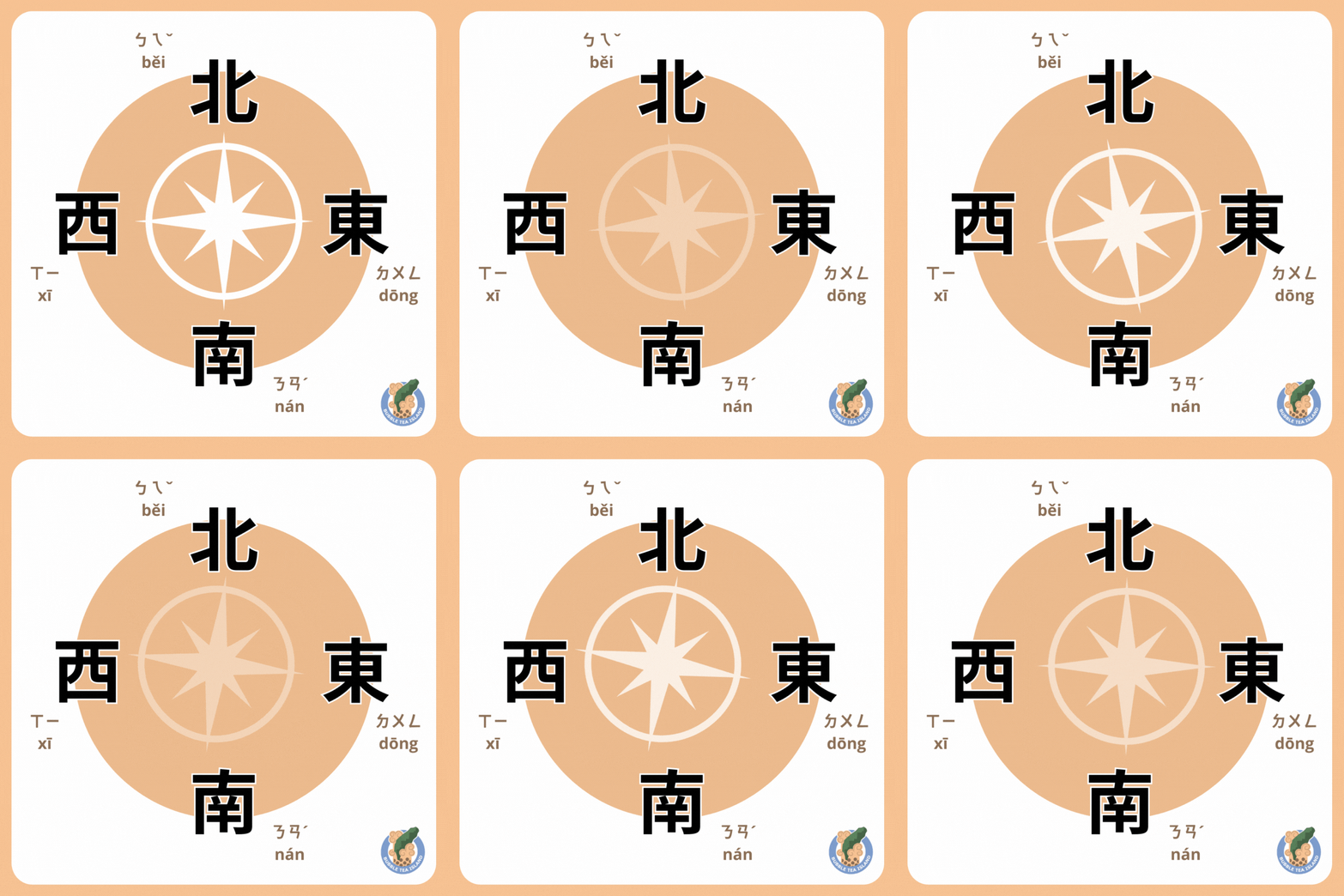
In Chinese, unlike in the West, directions are consistently listed in a clockwise manner starting with east: “東 (ㄉㄨㄥ – Dōng), 南 (ㄋㄢˊ – Nán), 西 (ㄒㄧ – Xī), 北 (ㄅㄟˇ – Běi).” East, South, West, North.
| Chinese | Bopomofo | Pinyin | English |
|---|---|---|---|
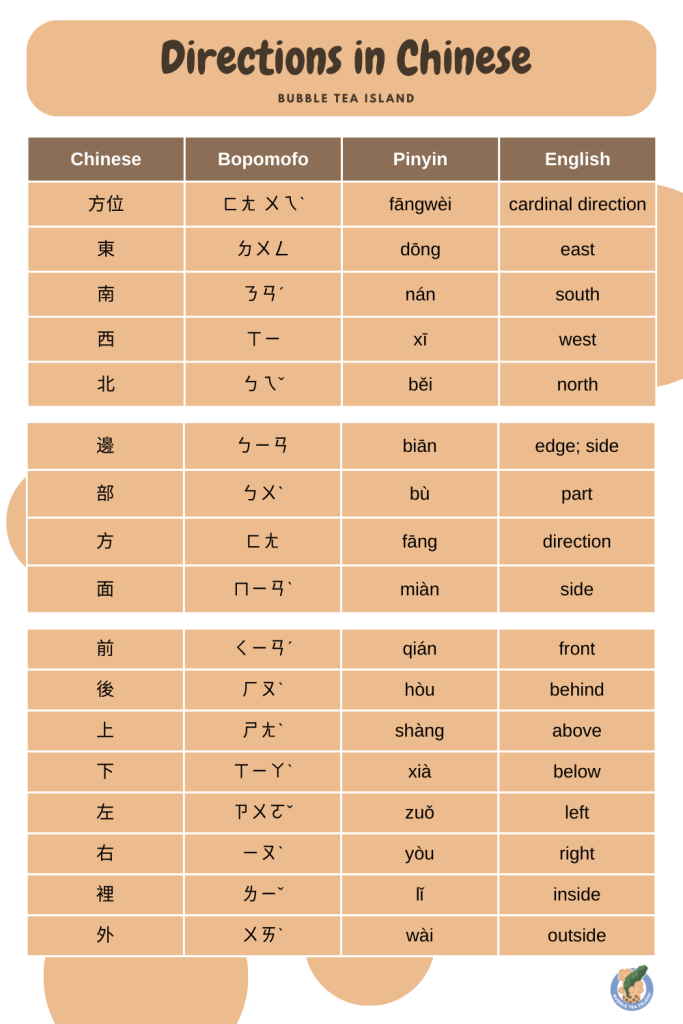
| 方位 | ㄈㄤ ㄨㄟˋ | fāngwèi | cardinal direction |
| 東 | ㄉㄨㄥ | dōng | east |
| 南 | ㄋㄢˊ | nán | south |
| 西 | ㄒㄧ | xī | west |
| 北 | ㄅㄟˇ | běi | north |
Fun fact: In Taiwan, three major cities are named according to their cardinal position on the island; Taipei (台北), Tainan (台南) and Taitung (台東).
Intercardinal Directions
Building upon cardinal directions, intercardinal directions provide a more detailed understanding of spatial relationships. These distinctions are particularly useful when navigating complex urban layouts or vast rural landscapes.
| Chinese | Bopomofo | Pinyin | English |
|---|---|---|---|
| 東北 | ㄉㄨㄥ ㄅㄟˇ | dōngběi | northeast |
| 西北 | ㄒㄧ ㄅㄟˇ | xīběi | northwest |
| 東南 | ㄉㄨㄥ ㄋㄢˊ | dōngnán | southeast |
| 西南 | ㄒㄧ ㄋㄢˊ | xīnán | southwest |
Side Words: 邊, 部, 方 and 面
Similar to the common practice in English, everyday Chinese also involves adding a “side word” to specify a direction. There are four primary side words:
| Chinese | Bopomofo | Pinyin | English |
|---|---|---|---|
| 邊 | ㄅㄧㄢ | biān | edge; side |
| 部 | ㄅㄨˋ | bù | part |
| 方 | ㄈㄤ | fāng | direction |
| 面 | ㄇㄧㄢˋ | miàn | side |
For example:
高雄在台灣的南部。
ㄍㄠ ㄒㄩㄥˊ ㄗㄞˋ ㄊㄞˊ ㄨㄢ ㄉㄜ˙ ㄋㄢˊ ㄅㄨˋ 。
gāoxióng zài táiwān de nánbù.
Kaohsiung in the south of Taiwan.
Positional Words
Positional words, such as 前 for front, 上 for above, 下 for below, and 後 for behind, add nuance to directions. For example, “在你的前面” (ㄗㄞˋ ㄋㄧˇ ㄉㄜ˙ ㄑㄧㄢˊ ㄇㄧㄢˋ) means “In front of you,” providing a more precise description of location. Integrating these words into directional communication enhances the speaker’s ability to convey spatial relationships effectively.
| Chinese | Bopomofo | Pinyin | English |
|---|---|---|---|
| 前 | ㄑㄧㄢˊ | qián | front |
| 後 | ㄏㄡˋ | hòu | behind |
| 上 | ㄕㄤˋ | shàng | above |
| 下 | ㄒㄧㄚˋ | xià | below |
| 左 | ㄗㄨㄛˇ | zuǒ | left |
| 右 | ㄧㄡˋ | yòu | right |
| 裡 | ㄌㄧˇ | lǐ | inside |
| 外 | ㄨㄞˋ | wài | outside |
Similar to cardinal words, positional words in Chinese are typically accompanied by one of the four side words.
For example:
商店在火車站前面。
ㄕㄤ ㄉㄧㄢˋ ㄗㄞˋ ㄏㄨㄛˇ ㄔㄜ ㄓㄢˋ ㄑㄧㄢˊ ㄇㄧㄢˋ 。
Shāngdiàn zài huǒchē zhàn qiánmiàn.
The shop is in front of the train station.
Vocabulary of Common Places in Chinese
Here is a short list of common places in Chinese:
| Chinese | Bopomofo | Pinyin | English |
|---|---|---|---|
| 火車站 | ㄏㄨㄛˇ ㄔㄜ ㄓㄢˋ | huǒchē zhàn | train station |
| 地鐵站 | ㄉㄧˋ ㄊㄧㄝˇ ㄓㄢˋ | dìtiě zhàn | metro station |
| 捷運站 | ㄐㄧㄝˊ ㄩㄣˋ ㄓㄢˋ | jiéyùn zhàn | MRT station |
| 公園 | ㄍㄨㄥ ㄩㄢˊ | gōngyuán | park |
| 商店 | ㄕㄤ ㄉㄧㄢˋ | shāngdiàn | store |
| 購物中心 | ㄍㄡˋ ㄨˋ ㄓㄨㄥ ㄒㄧㄣ | gòuwù zhòngxīn | mall |
| 學校 | ㄒㄩㄝˊ ㄒㄧㄠˋ | xuéxiào | school |
| 醫院 | ㄧ ㄩㄢˋ | yīyuàn | hospital |
| 機場 | ㄐㄧ ㄔㄤˊ | jīchǎng | airport |
| 銀行 | ㄧㄣˊ ㄏㄤˊ | yínháng | bank |
| 博物館 | ㄅㄛˊ ㄨˋ ㄍㄨㄢˇ | bówùguǎn | museum |
| 十字路口 | ㄕˊ ㄗˋ ㄌㄨˋ ㄎㄡˇ | shízìlù kǒu | crossroad |

Join our Substack “Mandarin Zest“, where we regularly share intermediate to advanced Chinese learning content. Make sure to subscribe!
 Bubble Tea Island