
Taiwan’s political landscape is as diverse and dynamic as its culture. The island nation, known for its vibrant democracy, boasts a multi-party system where various political parties compete for power. Each of these parties has a distinct identity, often encapsulated in their logos, which serve as visual representations of their ideologies, values, and histories. This article delves into the logos of Taiwan’s main political parties, exploring their symbolism and significance.
Pan-Green Coalition
The Pan-Green Coalition favors Taiwan’s independence, along with more liberal and progressive legislations. While all legislators and the majority of local leaders and councilors in the pan-green coalition belong to the Democratic Progressive Party (DPP), the coalition also includes five minor political parties.
Democratic Progressive Party (DPP) 民主進步黨
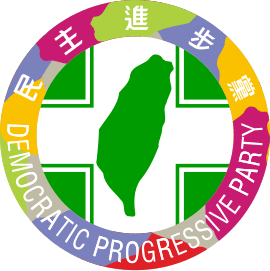
The DPP’s logo features a green map of Taiwan overlaid with a white cross. The map is enclosed within a circular multicolor border, with the name of the party inscribed in both Chinese and English.
While the party flag is enshrined in its constitution, its actual meaning is not explicitly defined. Some might say that the green color in the logo represents the DPP’s association with Taiwan’s native population and its advocacy for environmental protection. The white cross signifies peace and the party’s commitment to democratic values. The inclusion of Taiwan’s map reflects the party’s focus on Taiwanese identity and self-determination.
New Power Party (NPP) 時代力量

The NPP’s logo features a bold yellow and black design, with a stylized ‘力‘, meaning strength.
The party was founded right after the Sunflower Movement, and its colors are directly inherited from it, using the colors of a sunflower: yellow petals and a black center. The logo aims to embody the core value of the party, which is to make Taiwan a place where everyone enjoys the basic dignity of being human, can pursue their dreams and protect their happiness, has a sense of national identity and belonging, and can participate in politics and make decisions independently.
Taiwan Solidarity Union (TSU) 台灣團結聯盟

The TSU’s political aim is the establishment of a Republic of Taiwan, which is represented in the party logo, featuring a stylized depiction of the ocean, the sun, and the island of Taiwan at its center.
While the DPP has often internally debated incorporating the outlying islands of Kinmen and Matsu into its logo, the TSU’s omission of these islands is a clear political statement.
Taiwan Statebuilding Party (TSP) 台灣基進

The TSP’s logo features a stylized ‘台‘ (the first Chinese character of the name Taiwan) on a firebrick background.
The presence of the character ‘台’ highlights the party’s political focus on Taiwanese identity, while the firebrick background symbolizes building or construction.
Green Party Taiwan (GPT) 台灣綠黨
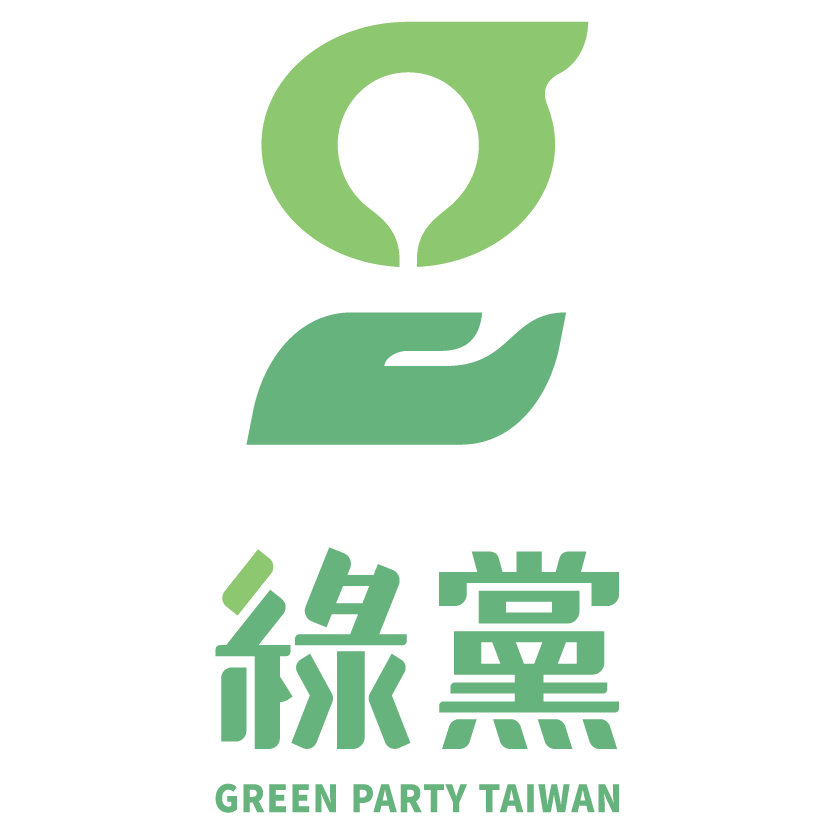
Although it belongs to the Green Coalition, its green color doesn’t share the same meaning as that of the DPP; instead, it aligns with the green parties worldwide, representing environmental issues.
In addition to the green color, the logo features a hand holding a leaf, further emphasizing its focus on the environment.
Social Democratic Party (SDP) 社會民主黨

The SDP’s logo features a multicolored rose. The rose is a well-known symbol of social democracy, gaining this significance due to its red color, which is itself a symbol of socialism.
The multicolored rose in the SDP’s logo also highlights the party’s diverse social values, such as support for labor rights and LGBT rights, and opposition to the death penalty.
Pan-Blue Coalition
The Pan-Blue Coalition favors closer relations with China, along with more conservative legislation. While the coalition is clearly dominated by the Kuomintang (KMT), it also includes three minor parties.
Kuamintang (KMT) 中國國民黨
The official English name of the party is the Chinese Nationalist Party, but it is more commonly referred to by its Chinese name, Kuomintang.
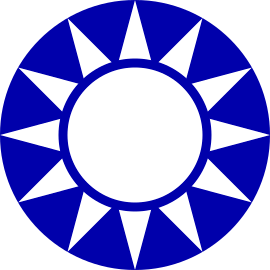
The KMT’s logo features a white sun with twelve rays on a blue background, resembling the national emblem of the Republic of China. The KMT’s emblem differs from the ROC’s in proportions; the ROC’s sun is smaller with more prominent blue sky, while the KMT’s sun rays extend to the borders of the emblem.
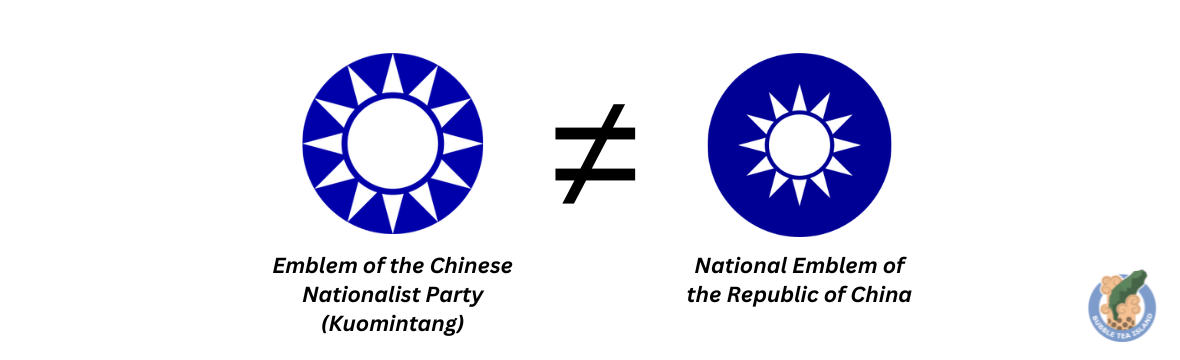
The twelve rays of the sun symbolize the twelve months of the year, representing the concept of time. The white sun on a blue background signifies brightness and purity, while the blue color represents justice, loyalty, and perseverance.
Given the party’s logo’s close association with the Republic of China, its political stance is quite clear: Chinese unification under the jurisdiction of the ROC.
Non-Partisan Solidarity Union (NPSU) 無黨團結聯盟

While its name might suggest otherwise, the party’s political orientation clearly aligns it with the Pan-Blue Coalition.
Its logo is arguably the least original among all political parties in Taiwan. It consists of a circle divided into gray and magenta segments. No information is available regarding the meaning of the logo.
People First Party (PFP) 親民黨
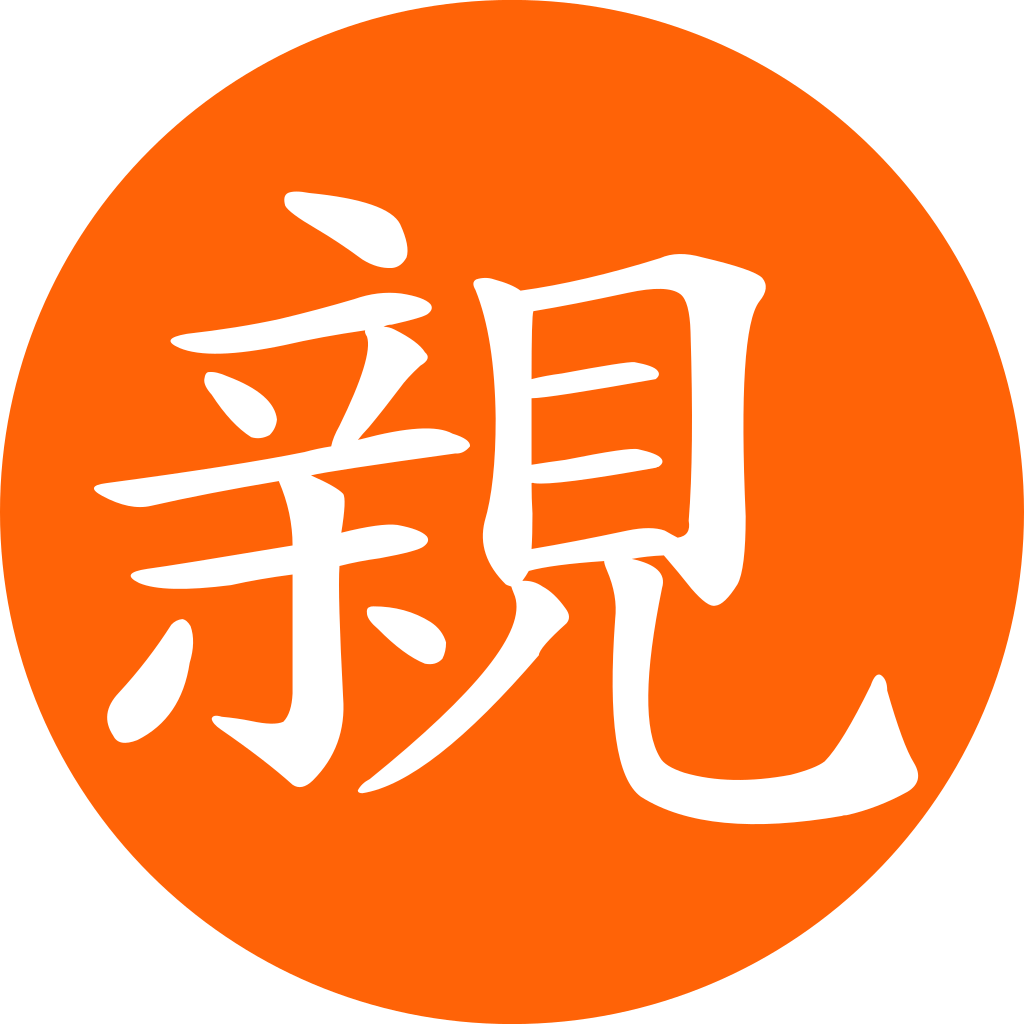
The PFP’s logo features the Chinese character 親 on an orange background.
The character 親 means ‘close’ or ‘intimate,’ symbolizing the close relationship the party aims to have with the people. Orange, in Confucianism, is associated with transformation.
New Party (NP) 新黨

The NP was created as a result of a split from the KMT, hence the name New Party.
The logo is not very original; it features the character 新黨, literally meaning ‘new party,’ written in blue on a yellow background.
Pan-White Coalition
While the Pan-White Coalition has portrayed itself as an alternative coalition, neither aligning with the DPP nor the KMT, recent elections have shown that it is essentially an extension of the Pan-Blue Coalition.
Taiwan People’s Party (TPP) 台灣民眾黨

The major party of this Pan-White Coalition and also the third major party in Taiwan, the TPP’s logo features the character 眾, meaning crowd, written in cyan blue on top of a white background (the white and cyan blue colors can be swapped).
Labor Party (LP) 勞動黨

Essentially Taiwan’s major Communist Party, LP supports Taiwan’s unification with China under the Chinese Communist Party (CCP). This ideology is clearly reflected in its logo, which features a red star on a red background—clear symbols of communism. Additionally, a green triangle is also present, representing either the island of Taiwan or land in general.

The logos of Taiwan’s political parties vividly reflect the nation’s diverse and dynamic political landscape. Each design encapsulates a party’s core values and aspirations, from the DPP’s emphasis on Taiwanese identity to the KMT’s historical roots. Smaller parties like the NPSU and Green Party Taiwan further illustrate Taiwan’s spectrum of political thought, showcasing a range of ideologies and priorities. Together, these logos offer a visual summary of Taiwan’s vibrant democracy and its evolving political discourse.
 Bubble Tea Island