
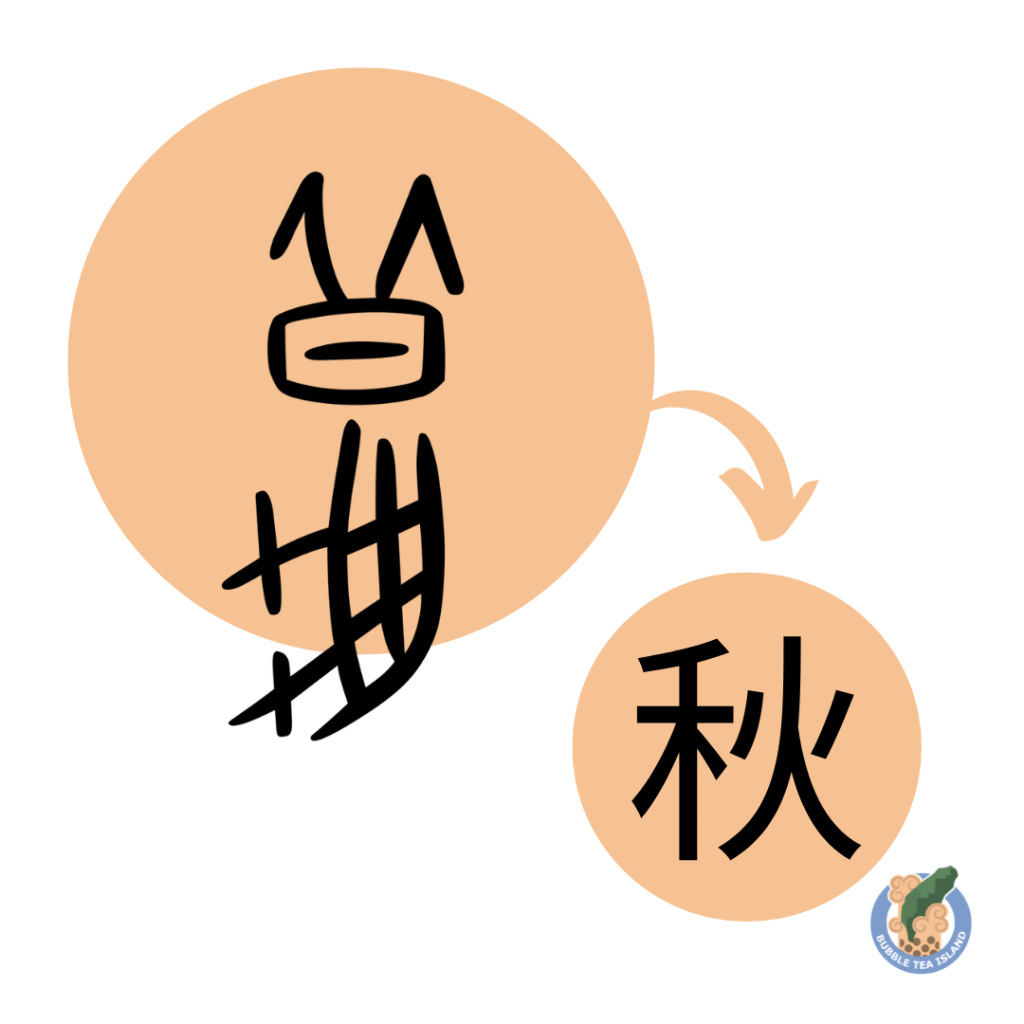
秋 is the character for “autumn”. It is made out of 9 strokes.
| Chinese Character | Simplified Version | Bopomofo | Pinyin |
|---|---|---|---|
| 秋 | 秋 | ㄑㄧㄡ | qiū |


Definition
Autumn; fall; harvest time; surname qiu
Historical Origins
The Chinese character 秋 has fascinating origins rooted in the agricultural practices and natural phenomena observed by ancient Chinese societies. Its earliest forms, seen in oracle bone script and bronze inscriptions, depict a cricket or locust, highlighting its connection to autumn—a season associated with the presence of these insects. Some of these ancient forms also included the fire (火) glyph, suggesting a link to the agricultural practice of burning fields after the harvest.
Over time, the character evolved into a phono-semantic compound. Its modern structure combines 禾 (hé, “grain”) as the semantic component, symbolizing the harvest season, with an abbreviated form of 𤒅 as the phonetic component, reflecting its Old Chinese pronunciation (*sʰɯw). This combination encapsulates the season’s agricultural significance while retaining the phonetic link.
In some interpretations, 秋 is also viewed as an ideogrammic compound, combining 禾 (grain) and 火 (fire). This reading evokes the practice of burning harvested fields to destroy locusts and their eggs, a crucial step in protecting future crops. This dual significance ties the character not only to the season of autumn but also to the cyclical nature of farming and pest control.
Vocabulary with the Character 秋
| Chinese | Bopomofo | Pinyin | English |
|---|---|---|---|
| 秋天 | ㄑㄧㄡ ㄊㄧㄢ | qiūtiān | Autumn; Fall |
| 秋季 | ㄑㄧㄡ ㄐㄧˋ | qiūjì | Autumn season |
| 中秋節 | ㄓㄨㄥ ㄑㄧㄡ ㄐㄧㄝˊ | Zhōngqiū Jié | Mid-Autumn Festival |
| 秋收 | ㄑㄧㄡ ㄕㄡ | qiūshōu | Autumn harvest |
Join our Substack “Mandarin Zest“, where we regularly share intermediate to advanced Chinese learning content. Make sure to subscribe!
 Bubble Tea Island