
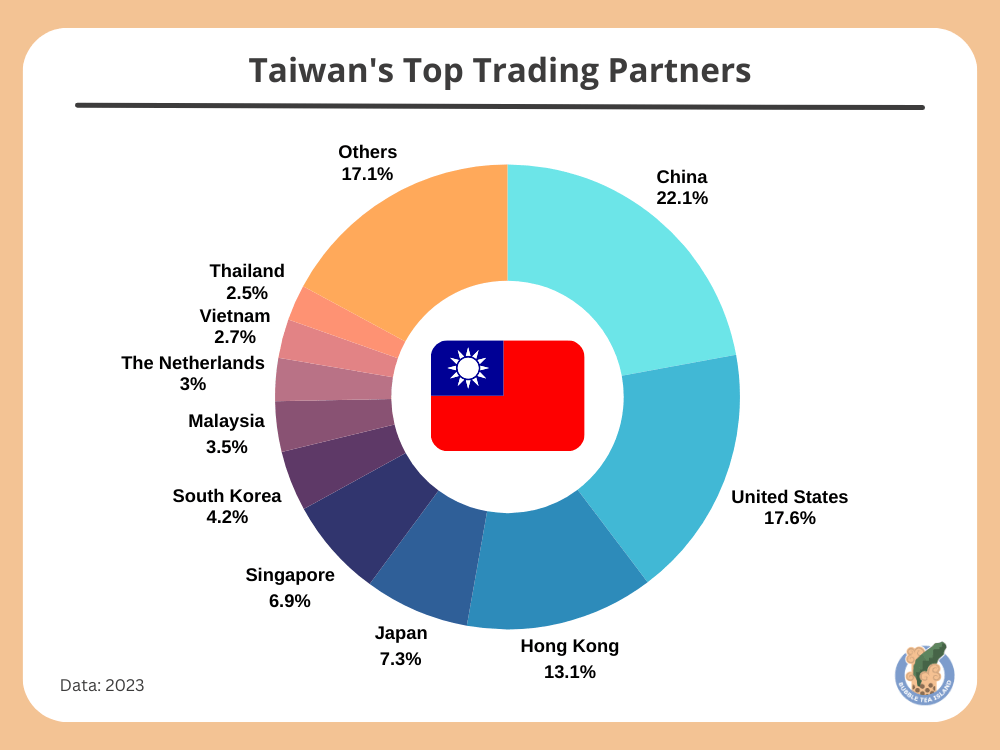
Taiwan, a global technology powerhouse, thrives on international trade, particularly in the semiconductor and electronics industries. In 2023, over 94.9% of Taiwan’s total exports were delivered to just 25 countries, highlighting the island’s strong trade ties with major global economies. This article explores Taiwan’s top trading partners and the key products that drive these relationships.
Taiwan’s Top Trading Partners in 2023
Below is a ranked list of Taiwan’s leading trade partners, showcasing the dollar value of Taiwanese exports to each country and their share of Taiwan’s total exports:
| Rank | Country | Amount (USD) | Percentage (%) |
|---|---|---|---|
| 1 | China | $95.7 billion | 22.1% |
| 2 | United States | $76.3 billion | 17.6% |
| 3 | Hong Kong | $56.5 billion | 13.1% |
| 4 | Japan | $31.4 billion | 7.3% |
| 5 | Singapore | $29.7 billion | 6.9% |
| 6 | South Korea | $18.2 billion | 4.2% |
| 7 | Malaysia | $15.2 billion | 3.5% |
| 8 | Netherlands | $12.9 billion | 3.0% |
| 9 | Vietnam | $11.7 billion | 2.7% |
| 10 | Thailand | $10.9 billion | 2.5% |
| 11 | Germany | $8.1 billion | 1.9% |
| 12 | India | $6.0 billion | 1.4% |
| 13 | Australia | $5.8 billion | 1.3% |
| 14 | Philippines | $5.1 billion | 1.2% |
| 15 | Mexico | $4.7 billion | 1.1% |
| 16 | United Kingdom | $3.6 billion | 0.8% |
| 17 | Indonesia | $3.0 billion | 0.7% |
| 18 | Belgium | $2.64 billion | 0.6% |
| 19 | Canada | $2.63 billion | 0.6% |
| 20 | Italy | $2.4 billion | 0.6% |
| 21 | France | $1.8 billion | 0.4% |
| 22 | United Arab Emirates | $1.55 billion | 0.4% |
| 23 | Türkiye | $1.47 billion | 0.3% |
| 24 | Poland | $1.42 billion | 0.3% |
| 25 | Spain | $1.4 billion | 0.3% |
These 25 countries dominate Taiwan’s export landscape, with electronics and technology products leading the way.
Insights into Taiwan’s Major Trade Relationships
Mainland China: Taiwan’s Largest Partner
Accounting for over a fifth of Taiwan’s total exports, mainland China remains its most significant trade partner. Semiconductor components such as electronic integrated circuits are pivotal to this trade relationship, driven by China’s demand for advanced technology in manufacturing and consumer electronics.
United States: A Growing Market
With $76.3 billion worth of Taiwanese exports in 2023, the United States is Taiwan’s second-largest partner. Computers and their parts dominate the export list, supported by Taiwan’s leading role in the global semiconductor industry.
Hong Kong: A Gateway to Mainland China
Despite its size, Hong Kong is Taiwan’s third-largest trading partner, serving as a re-export hub for goods destined for mainland China and beyond.
Asia’s Role in Taiwan’s Trade
Countries such as Japan, Singapore, South Korea, Malaysia, and Vietnam also play critical roles in Taiwan’s trade network, importing components essential for manufacturing industries.
Europe and the Americas: Emerging Opportunities
European countries such as Germany, Netherlands, and United Kingdom are increasingly importing high-tech goods from Taiwan. Similarly, countries like Mexico and Canada in the Americas showcase Taiwan’s expanding reach into North American markets.

Taiwan’s strong trade relationships are a testament to its advanced manufacturing capabilities, particularly in semiconductors and technology. Its strategic location in East Asia and a well-established global supply chain network make it a vital player in international trade. By understanding Taiwan’s top trading partners, businesses and policymakers can identify opportunities to enhance economic cooperation with this dynamic island nation.
FAQ
Why is mainland China Taiwan’s largest trading partner?
Mainland China’s demand for semiconductors and technology products aligns with Taiwan’s strength in these industries, making it the largest trade partner.
What are Taiwan’s main exports?
Taiwan’s exports are led by semiconductors, flat panel displays, computers, and related components.
How does Taiwan maintain strong trade ties globally?
Taiwan’s advanced manufacturing sector, strategic location, and integration into global supply chains underpin its robust trade relationships.
 Bubble Tea Island