
If you’ve spent any time in Taiwan or browsed Taiwanese internet slang, you’ve likely come across the term 靠北 (Kaobei). This expression, deeply rooted in Taiwanese culture, has a colorful range of meanings and uses. But what exactly does it mean, and where does it come from?
Origins and Meaning of 靠北 (Kaobei)
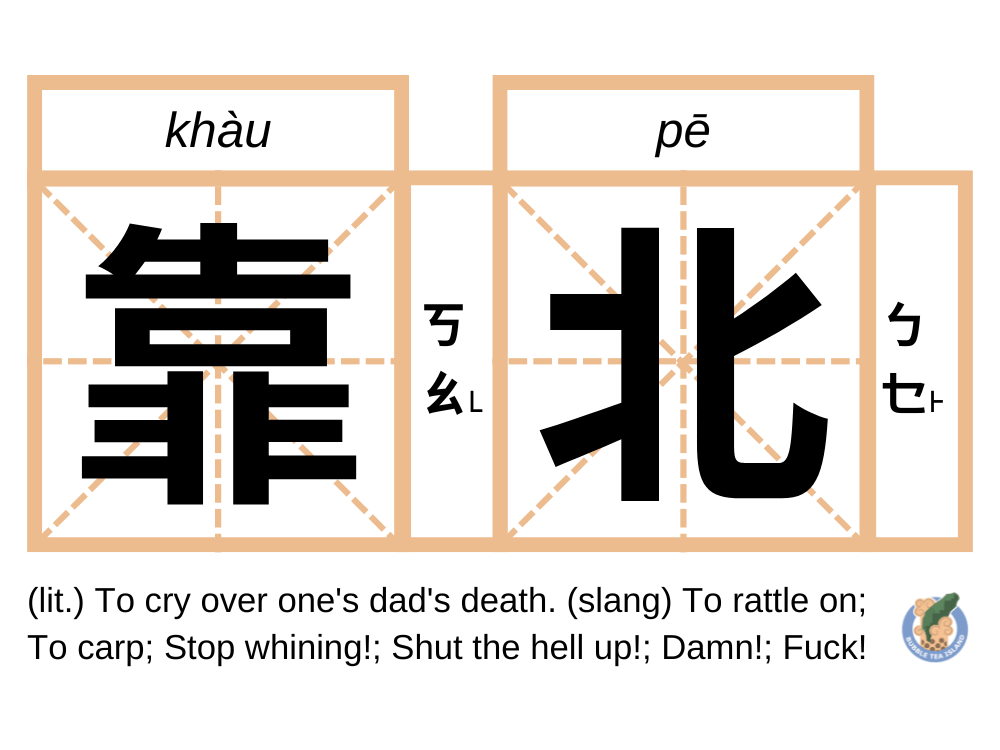
The term 靠北 is actually a phonetic transliteration of the Taiwanese Hokkien phrase 哭爸 (pronounced khàu‑pē in the Tailo Romanization system). Literally, it means “to cry over one’s dad’s death.” However, its modern usage in Taiwanese slang is far removed from this mournful context.
In everyday speech and online platforms, 靠北 is used to describe someone who is:
- Complaining excessively
- Nitpicking or criticizing endlessly
- Whining or ranting about trivial matters
The tone often carries a sense of irritation or dismissal, making it akin to phrases like “stop whining,” “shut the hell up,” or even a curt “damn!” in English. It can also serve as a general expletive, much like “fuck!”
Phonetics and Writing
In Taiwanese Hokkien, 靠北 is pronounced as:
- Bopomo (臺語注音): ㄎㄠ˪ ㄅㆤ˫
- Tailo Romanization: khàu‑pē
Despite its Hokkien roots, 靠北 is most often written with Mandarin characters. The characters 靠北 don’t reflect the original meaning (“to cry over one’s dad’s death”) but are instead used as a phonetic approximation for the Hokkien pronunciation.
While some purists might insist on using the correct characters 哭爸, it’s rare to see this version in practice. 靠北 has become the standard form in both digital and spoken Taiwanese culture.
How 靠北 Is Used
Although 靠北 originates from Taiwanese Hokkien, it has been fully embraced in Taiwan’s Mandarin, becoming a common expression you’ll hear frequently in everyday conversations.
- To Complain or Whine 靠北 is often used when someone is perceived to be whining or venting excessively about minor inconveniences.
- Example:
- 他一直靠北這個問題,真煩!
- (Tā yīzhí kàoběi zhège wèntí, zhēn fán!)
- “He keeps whining about this issue—it’s so annoying!”
- Example:
- As an Interjection It can also serve as an expletive, expressing frustration or disbelief, much like “damn!” or “fuck!” in English.
- Example:
- 靠北!怎麼又壞掉了?
- (Kàoběi! Zěnme yòu huàidiàole?)
- “Damn! Why did it break again?”
- Example:
- In Memes and Internet Culture 靠北 is a staple in Taiwanese memes and social media. The phrase often appears in posts or groups dedicated to venting about specific topics. For example:
- 靠北老闆 (Kaobei laoban) – A group where people complain about their bosses.
- 靠北男友 (Kaobei nanyou) – A space for venting about boyfriends.
Cultural Context
Using 靠北 in casual conversation or online is widely accepted in Taiwan, especially among younger generations. However, it’s important to note that 靠北 is still considered informal and potentially offensive in certain contexts. Using it with elders, in professional settings, or in formal writing might come across as disrespectful.
In Summary
靠北 (Kaobei) is a quintessential Taiwanese expression, blending Hokkien linguistic roots with a modern, slangy twist. While it started with a somber literal meaning (“to cry over one’s dad’s death”), it has evolved into a versatile term for whining, venting, or expressing frustration.
Whether you’re navigating Taiwanese social media or chatting with friends in Taiwan, knowing when and how to use 靠北 can help you sound more natural—and maybe even score a laugh or two!
So next time someone’s rattling on about something trivial, don’t be surprised if you hear: “別靠北啦!” (Bié kàoběi la! – “Stop whining already!”).
 Bubble Tea Island