
“Kan Ni Nia Ji Bai” (幹你娘雞掰 or 姦恁娘膣屄) is a pretty strong and offensive phrase in Taiwanese, often used when people are angry or joking around with friends. It’s definitely not something you’d want to use in polite conversation. Learning about expressions like this can give you a better feel for the language, but it’s best to understand them without actually saying them unless you know exactly what you’re doing!
Breaking Down the Phrase
- Taiwanese Characters: 姦恁娘膣屄
- Mandarin Characters: 幹你娘雞掰
- Mandarin Pinyin: Gàn nǐ niáng jī bāi
- Bopomo (臺語注音): ㄍㄢ˪ ㄌㄧㄣˋ ㄋㄧㄚˊ ㄐㄧ ㆠㄞ
- Tailo Romanization: Kàn lín niâ tsi‑bai
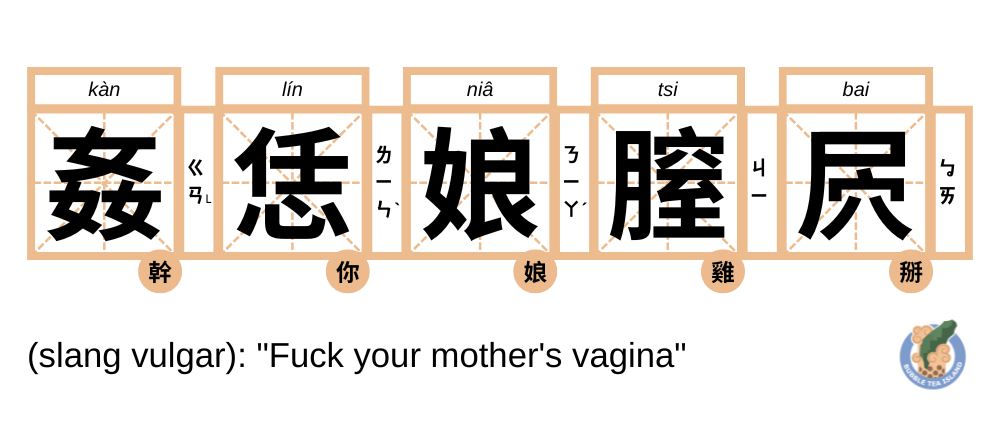
“Kan Ni Nia Ji Bai” (幹你娘雞掰) is a profanity in Taiwanese, and it translates roughly to “F*** your mother’s vagina” in English.
- 幹 (姦): A verb meaning “to f***”.
- 你娘 (恁娘): “Your mother.”
- 雞掰 (膣屄): A slang term for female genitalia, often considered a harsh or vulgar expression.
In its orthodox Taiwanese Hokkien form, the phrase would be written as 姦恁娘膣屄. However, when used in Mandarin speech, it is almost always written as 幹你娘雞掰, a mix of Mandarin characters and Taiwanese pronunciation that makes it easier for Mandarin speakers to recognize and use. This adaptation reflects how Taiwanese expressions are often blended into Mandarin while retaining their original meaning.
Understanding Taiwanese Profanity in Context
Swearing in Taiwanese is an integral part of the language’s colorful expression. Some points to consider about Taiwanese swearing culture:
- Common in Everyday Life: Taiwanese people are expressive, and swearing can be a normal part of casual speech, especially in emotional or intense moments.
- Playful Usage: Among friends, profanities can lose their edge and become a form of camaraderie or humor.
- Regional Variations: While this phrase is commonly used, different regions of Taiwan or Hokkien-speaking areas may have their own unique slangs or profanities.
- Not Always Literal: Similar to English swearing, the meaning is often not intended literally but as a way to vent emotions.
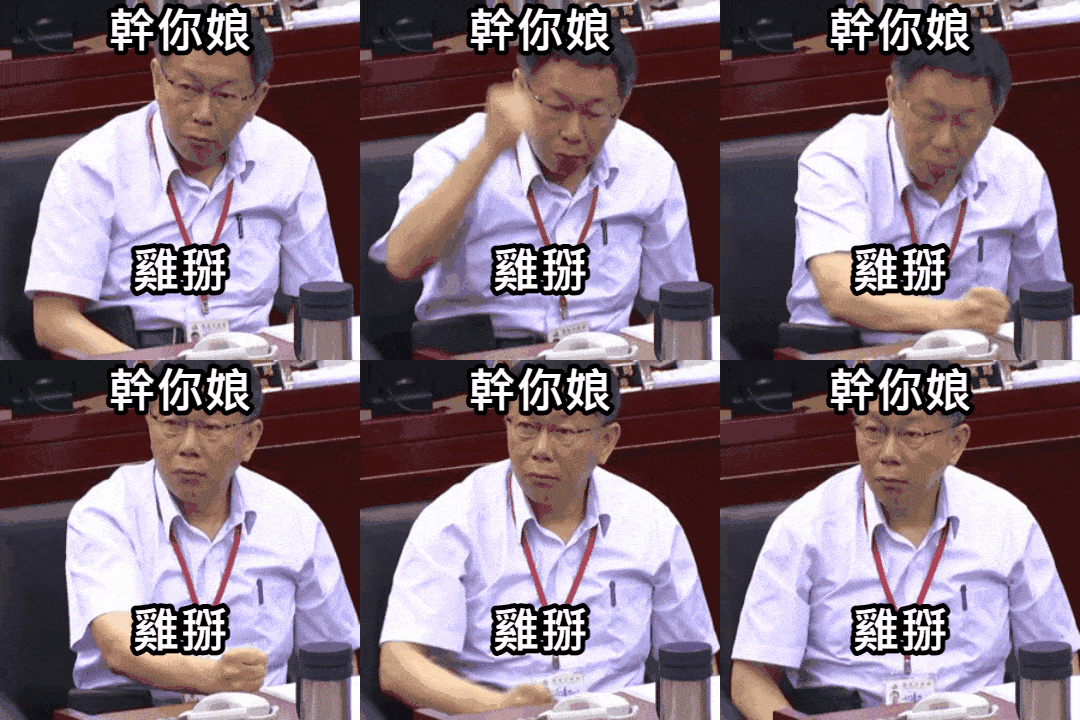
Swearing can be an interesting part of learning a language, helping you get a better feel for the culture. Just remember to always use these words in the right context!
Have you heard any similar phrases in Taiwanese Hokkien? Let us know in the comments!
 Bubble Tea Island