

The terms “One-China Principle” and “One-China Policy” often surface in discussions about international relations, particularly in the context of cross-strait relations between China and Taiwan. While they may sound similar, these terms have distinct meanings and implications for global diplomacy. In this article, we will clarify their differences and why understanding them is essential for grasping the complexities of East Asian geopolitics.
What Is the One-China Principle?
The One-China Principle is a cornerstone of the People’s Republic of China’s (PRC) foreign policy. It asserts that there is only one China in the world, and Taiwan is an inseparable part of China. According to this principle, the PRC government in Beijing is the sole legitimate government of China.
This principle forms the basis of the PRC’s stance on Taiwan, which it views as a breakaway province that must eventually be reunified with the mainland, by force if necessary. The One-China Principle leaves no room for any interpretation of Taiwan as a separate or independent state.

What Is the One-China Policy?
The One-China Policy, on the other hand, refers to the diplomatic framework adopted by some countries that seek to establish or maintain official relations with the PRC, while keeping friendly relations with Taiwan. Under this policy, countries acknowledge the existence of “one China,” but the interpretation of what constitutes “China” varies.
For example:
- The United States, under the Taiwan Relations Act, recognizes the PRC as the official government of China but does not explicitly endorse Beijing’s claim over Taiwan. Instead, it maintains unofficial relations with Taiwan while adhering to the One-China Policy.
- Other nations, like the United Kingdom and Australia, similarly follow the One-China Policy to establish formal ties with the PRC while continuing informal interactions with Taiwan.
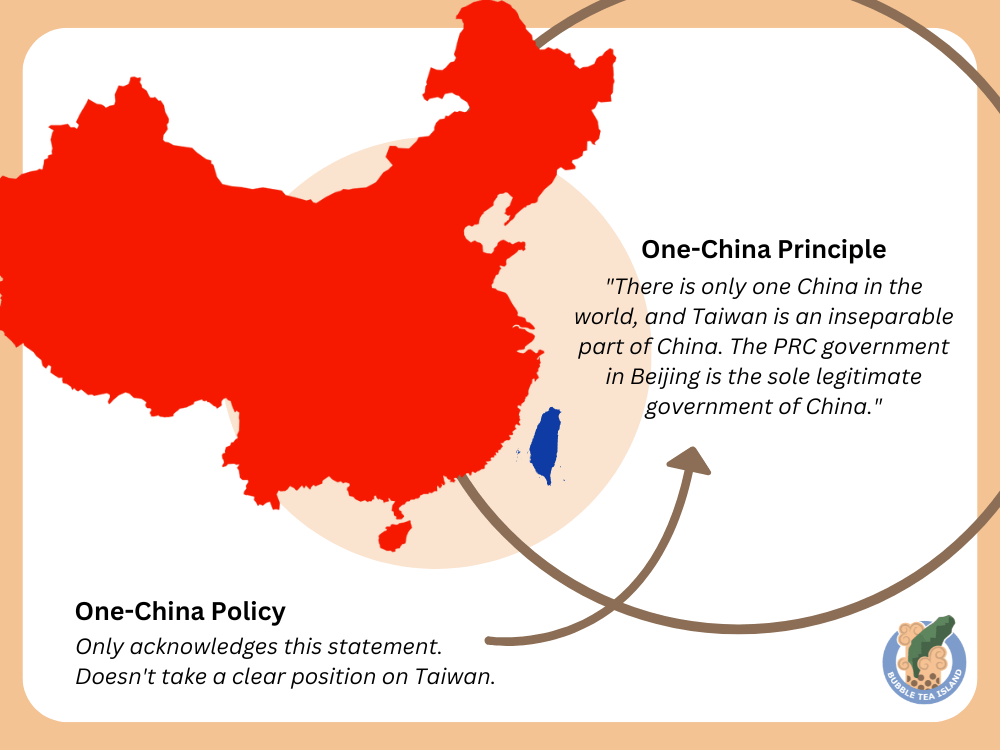
Key Differences Between the Two
| Aspect | One-China Principle | One-China Policy |
|---|---|---|
| Origin | Established by the PRC | Adopted by some foreign governments |
| Core Belief | Taiwan is an inseparable part of China | Acknowledges the existence of “one China” |
| Flexibility | No room for interpretation | Open to varying interpretations |
| Purpose | Reflects Beijing’s stance | Facilitates international diplomacy |
Why the Difference Matters
Understanding the distinction between the One-China Principle and the One-China Policy is crucial for analyzing international relations. The principle reflects the PRC’s unwavering stance on its sovereignty, while the policy represents how other nations navigate their diplomatic relations with both Beijing and Taipei.
This distinction is especially significant in scenarios such as:
- US-Taiwan Relations: The United States balances its adherence to the One-China Policy with its commitments under the Taiwan Relations Act, which includes providing Taiwan with defensive arms.
- Cross-Strait Tensions: Beijing’s emphasis on the One-China Principle underpins its military maneuvers and diplomatic pressure on countries that engage with Taiwan.
- Global Diplomacy: Nations must carefully craft their positions to maintain economic and political ties with the PRC while addressing domestic and international concerns about Taiwan’s autonomy.

Does the ROC (Taiwan) also have a One-China Principle/ Policy?
Of course, while in practice the government based in Taiwan no longer seeks to unify the mainland, its constitution remains unchanged and therefore continues to claim the entirety of China as its territory.
The ROC constitution stipulates that no modification to the national territory can be made without a resolution by the National Assembly. It is important to note that the National Assembly—designed as a representative body for all of China and therefore incompatible with the current reality in Taiwan—was dissolved in 2005. It would only be reestablished if the ROC were to unify the country. In other words, the ROC can only legally relinquish its claim to the mainland if it first regains control over it.
Moreover, the ROC has its own version of a One-China Principle, articulated in the Supreme Court of the Republic of China Ruling Case No. 8219. This ruling stipulates that although the ROC has lost control of the mainland to the communists, the mainland territory and its people should still be considered an inalienable part of the Republic.

The One-China Principle and the One-China Policy are central to understanding the geopolitical dynamics of East Asia. While the principle represents Beijing’s unyielding position on Taiwan, the policy demonstrates the flexibility employed by other nations to navigate their relationships with the PRC and Taiwan. By appreciating these differences, observers and policymakers can better comprehend the nuances of this critical global issue.
 Bubble Tea Island