

If you’ve ever attended a motivational talk or read a self-help book, you might have heard that the Chinese word for “crisis” (危機, wēijī) is a combination of two characters meaning “danger” (危, wēi) and “opportunity” (機, jī). It’s a catchy idea that suggests every challenging situation holds potential for growth. However, it is not accurate. The Chinese word for crisis (危機) doesn’t mean “danger + opportunity”.
In this article, we’ll explore why this claim is incorrect, where the misunderstanding comes from, and what the Chinese characters in 危機 actually mean. Let’s dive in and separate fact from fiction.
The Myth of “Danger + Opportunity”
The myth about the meaning of 危機 started gaining traction in the West during the mid-20th century. One of the earliest mentions in English can be traced back to missionaries in China in the 1930s. However, it was popularized by figures like John F. Kennedy, who used it as a rhetorical device in his speeches. The idea is undeniably appealing: in every crisis, there’s a chance for success.
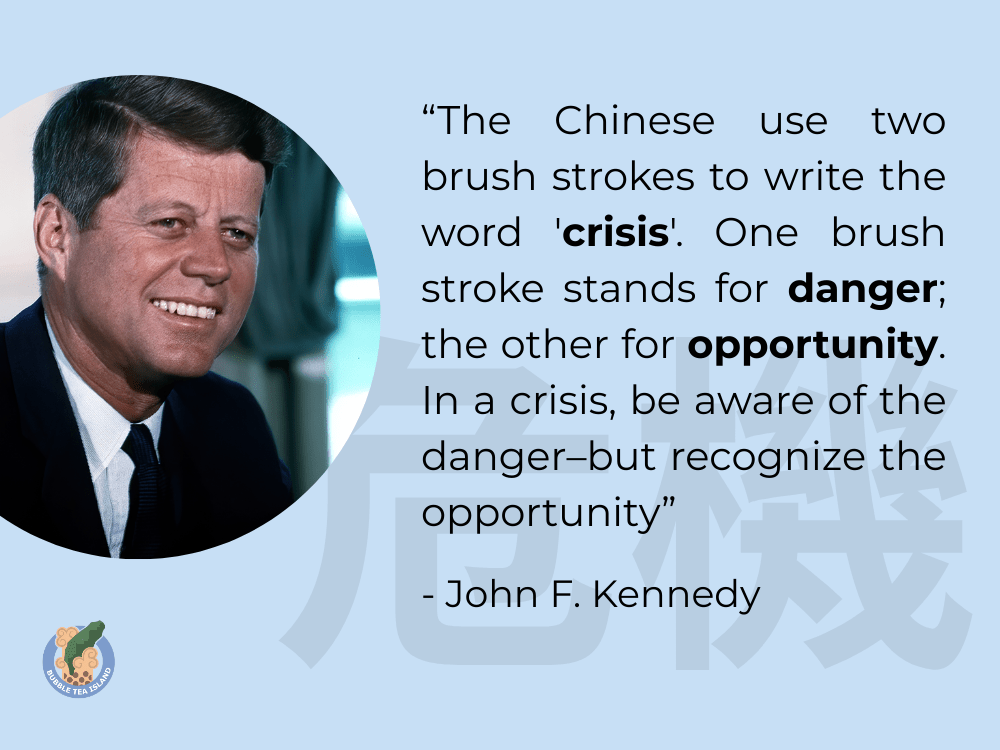
However, linguists and Chinese language experts have debunked this interpretation. While the first character (危, wēi) does mean “danger,” the second character (機, jī) has a much more nuanced meaning that doesn’t directly translate to “opportunity.”
What Does 危機 Really Mean?
To understand why this phrase doesn’t mean “danger + opportunity,” let’s break down its components:
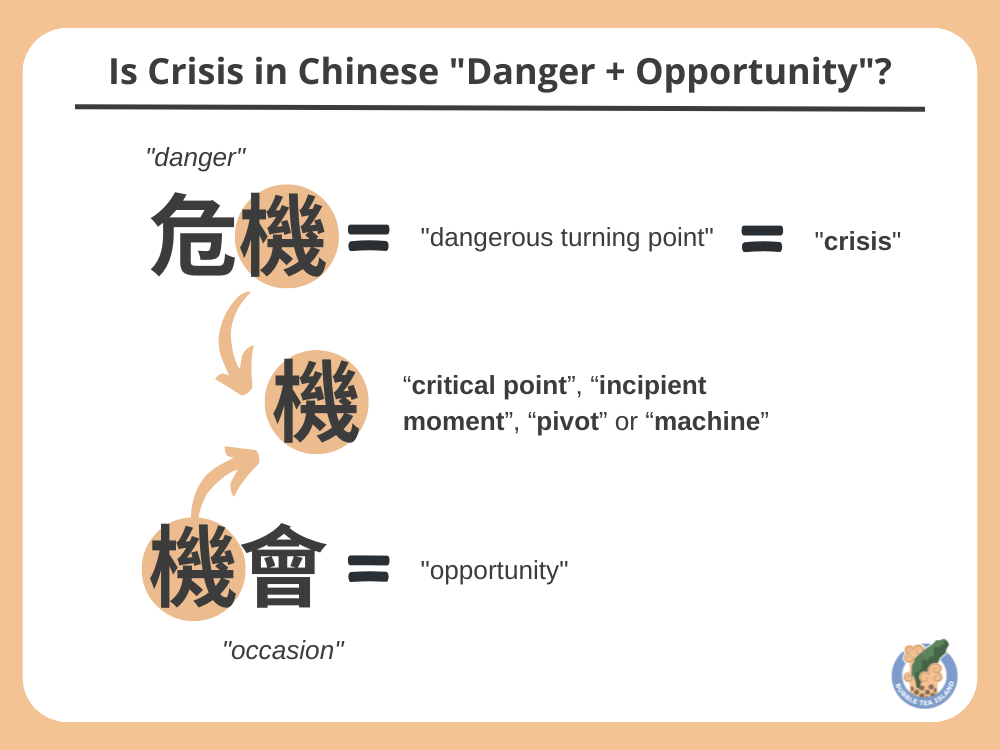
- 危 (wēi): This character unambiguously means “danger” or “precarious.” It conveys a sense of risk or threat, much like its English equivalent.
- 機 (jī): This is where things get tricky. The character jī is polysemous, meaning it has multiple meanings depending on context. For instance, when jī is combined with huì (會), which means “occasion,” it forms the Mandarin word 機會 (jīhuì), meaning “opportunity.” However, by itself, jī does not mean “opportunity.” Instead, in 危機 (wēijī), jī refers to a “critical point,” “incipient moment,” or a “pivot.” Essentially, it denotes a turning point or a situation in flux, which could lead to either positive or negative outcomes—unlike 機會, where the context points specifically to favorable circumstances.
When combined, 危機 describes a precarious situation that demands careful handling—not necessarily an opportunity for growth.
Crisis: A Turning Point, Not a Promise
The true essence of 危機 lies in its portrayal of a critical juncture. A crisis is indeed a time of danger, but whether it turns into an opportunity depends on how it’s handled. This nuanced perspective is closer to the real meaning of the word.
Understanding 危機 as a moment of potential change rather than a guaranteed opportunity reminds us to tread carefully during uncertain times. It’s a call for vigilance and adaptability, rather than blind optimism.

Join our Substack “Mandarin Zest“, where we regularly share intermediate to advanced Chinese learning content. Make sure to subscribe!
 Bubble Tea Island