

Numbers in Chinese start off deceptively simple.
You breeze through 一、二、三、四、五 without breaking a sweat. Counting to ten? No problem. Counting to a hundred? Still smooth.
And then, suddenly…
You hit 萬/万 — and the entire number system flips upside down.
Anyone who’s learned Chinese knows this moment well. One minute you’re confidently reading prices and phone numbers, and the next you’re staring at a string like 三十五萬八千 wondering why your brain is buffering.
It’s not your fault.
It’s the system.
The Big Shift: Chinese Thinks in Tens of Thousands, Not Thousands
English groups large numbers by thousands:
- 1 thousand (1,000)
- 1 million (1,000,000)
- 1 billion
- 1 trillion
- and so on
Chinese, however, organizes numbers by ten-thousands (10,000). That single concept changes everything.
Here’s the basic hierarchy:
- 萬 (wàn) → 10,000
- 億 (yì) → 100,000,000 (10⁸)
- 兆 (zhào) → 1,000,000,000,000 (10¹²)
- 京 (jīng) → 10¹⁶
This means:
- 10,000 = 一萬 (literally “one ten-thousand”)
- 100,000,000 = 一億
- 1,000,000,000,000 = 一兆
- 10,000,000,000,000,000 = 一京
If you grew up thinking in thousands, it’s jarring.
But once you retrain your brain to think in units of 萬, the structure actually feels surprisingly elegant.
But Here’s the Fascinating Part… 萬 Didn’t Even Mean “Ten Thousand” Originally
The character 萬 has a long, curious history.
In its earliest forms, 萬 didn’t mean ten thousand at all. It depicted a scorpion 🦂 — a creature seen as abundant, dangerous, and symbolically powerful. Over time, the meaning shifted from “scorpion” to “countless” or “myriad,” representing an extremely large, almost immeasurable number.
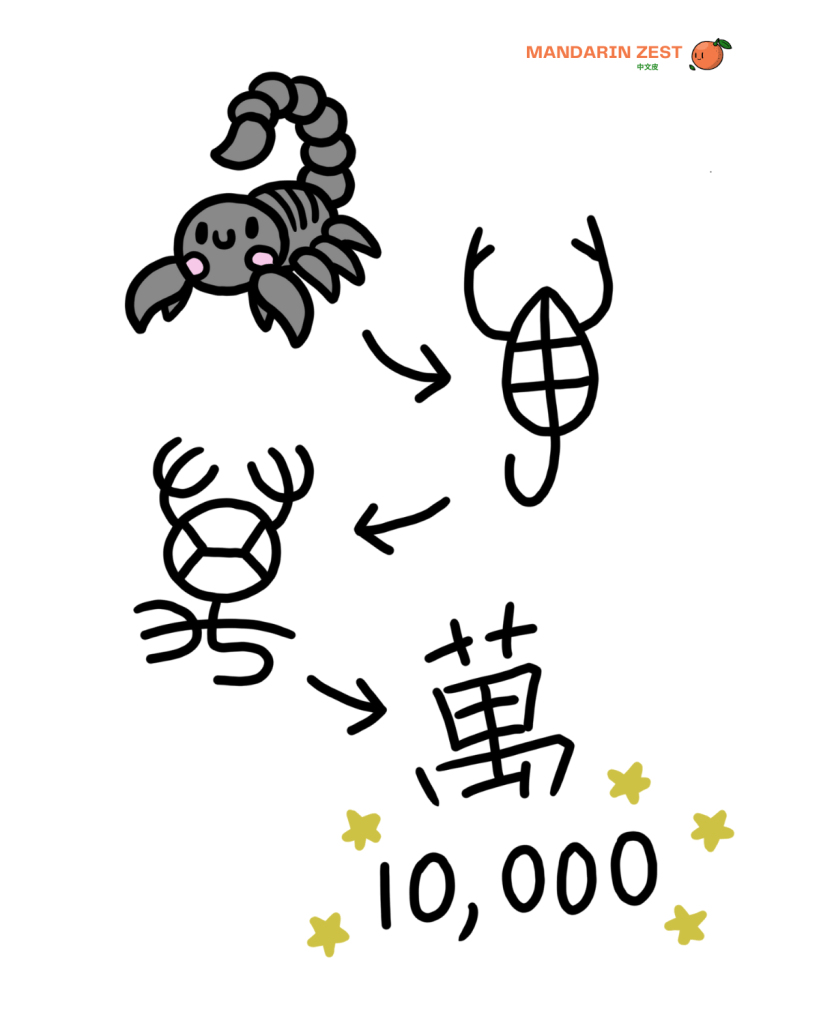
Eventually, this idea of countlessness solidified into a specific value: 10,000, the largest “complete” unit in classical Chinese thought.
Because of this evolution, 萬 became loaded with cultural meaning, far beyond math.
You still see it today:
- 萬歲! — “Long live!” (literally “ten thousand years”)
- 萬事如意 — “May all things go as you wish”
- 萬物 — “All things under heaven; everything in the universe”
So even now, 萬 has two layers of meaning:
- Literal: 10,000
- Figurative: countless, infinite, all
A Symbol That Outlived Its Math
Long before larger numerical units like 億 existed, 萬 was already used as the ultimate expression of large quantity. Even after new units emerged, its symbolic power stayed intact.
This is why in literature and philosophy, 萬 often appears metaphorically rather than mathematically.
Take 萬里長城 (Wànlǐ Chángchéng), the Great Wall of China.
It doesn’t mean the wall is literally 10,000 li long. The number instead conveys vastness, grandeur, and endurance.
Chinese thought infused numbers with meaning — not just quantity, but symbolism.
So How Do You Survive Large Chinese Numbers?
When you hear something like:
三十五萬八千
Don’t panic.
Just regroup your brain:
- Identify the 萬: 三十五萬 = 35 × 10,000 = 350,000
- Add the rest: + 8000
- Result: 358,000
Once you switch into the “ten-thousand mindset,” everything clicks.
You’re not just learning vocabulary.
You’re learning a worldview — one where numbers have carried 2,000 years of history, philosophy, and symbolism.
A Final Thought from Mencius
To truly appreciate the elegance of Chinese numbers, I’ll leave you with a line from Mencius:
「萬取千焉,千取百焉,不為不多矣。」
Take a thousand from ten thousand, and a hundred from a thousand — either way, it’s still quite a lot.
Even Mencius knew: numbers only make sense when you understand the unit behind them.
Join our Substack “Mandarin Zest“, where we regularly share intermediate to advanced Chinese learning content. Make sure to subscribe!
 Bubble Tea Island