
Learning how to count and use numbers in Chinese is essential for anyone looking to communicate effectively in Taiwan or engaging in business dealings with Taiwanese or Chinese companies. In this article, we’ll explore the basics of numbers in Chinese.

Cardinal Numbers
Cardinal numbers in Chinese are composed of simple characters and are relatively easy to learn.
Numbers from 0 to 99
The first ten numbers are the most basic and important numbers in Chinese. They are represented by the following characters:
| Character | Bopomofo | Pinyin | English |
|---|---|---|---|
| 零 | ㄌㄧㄥˊ | líng | zero |
| 一 | ㄧ | yī | one |
| 二 | ㄦˋ | èr | two |
| 三 | ㄙㄢ | sān | three |
| 四 | ㄙˋ | sì | four |
| 五 | ㄨˇ | wǔ | five |
| 六 | ㄌㄧㄡˋ | liù | six |
| 七 | ㄑㄧ | qī | seven |
| 八 | ㄅㄚ | bā | eight |
| 九 | ㄐㄧㄡˇ | jiǔ | nine |
| 十 | ㄕˊ | shí | ten |
After the first ten numbers, the Chinese number system follows a regular pattern. For example, the number 11 is 十一 (ㄕˊ ㄧ), which means “ten-one”. The number 12 is 十二 (ㄕˊ ㄦˋ), which means “ten-two”, 23 is 二十三 (ㄦˋ ㄕˊ ㄙㄢ), 57 is 五十七(ㄨˇ ㄕˊ ㄑㄧ), and so on.
💡 The number two (兩 – ㄌㄧㄤˇ)
The number two (二) becomes 兩 when used to enumerate something, like two cups should be 兩杯 and not 二杯.
Large numbers
| Chinese | Bopomofo | Pinyin | English |
|---|---|---|---|
| 百 | ㄅㄞˇ | bǎi | 100 |
| 千 | ㄑㄧㄢ | qiān | 1,000 |
| 萬 | ㄨㄢˋ | wàn | 10,000 |
| 億 | ㄧˋ | yì | 100,000,000 |
In Chinese, large numbers are counted in units of ten thousand (萬). For example, 100,000 is 十萬, 1,000,000 is 百萬, and 10,000,000 is 千萬. To express numbers beyond 10,000,000, the Chinese language uses a similar system of counting based on units of 100 million (億).
Ordinal Numbers
Ordinal numbers in Chinese are used to indicate order or rank. They are formed by adding the character 第 (ㄉㄧˋ – dì) before the cardinal number. For example:
- 第一 (ㄉㄧˋ ㄧ) – first
- 第二 (ㄉㄧˋ ㄦˋ) – second
- 第三 (ㄉㄧˋ ㄙㄢ) – third
- 第四 (ㄉㄧˋ ㄙˋ) – fourth
- 第五 (ㄉㄧˋ ㄨˇ) – fifth
- …
Years and phone numbers
When saying phone numbers and years in Chinese, each digit is pronounced separately. For example, if your phone number is 1234567890, you would say it as 一二三四五六七八九零 (ㄧ ㄦˋ ㄙㄢ ㄙˋ ㄨˇ ㄌㄧㄡˋ ㄑㄧ ㄅㄚ ㄐㄧㄡˇ ㄌㄧㄥˊ), and for the year 2023 you would say it as 二零二三 (ㄦˋ ㄌㄧㄥˊ ㄦˋ ㄙㄢ).
Measure words
Measure words are used to quantify a noun, much like how we use the words “a” or “an” in English. In Chinese, measure words come after the number and before the noun, indicating the quantity or amount of the object being described. For example, the measure word for “people” in Chinese is 個 (ㄍㄜˋ). So, to say “two people” in Chinese, you would say “兩個人” (ㄌㄧㄤˇ ㄍㄜˋ ㄖㄣˊ).
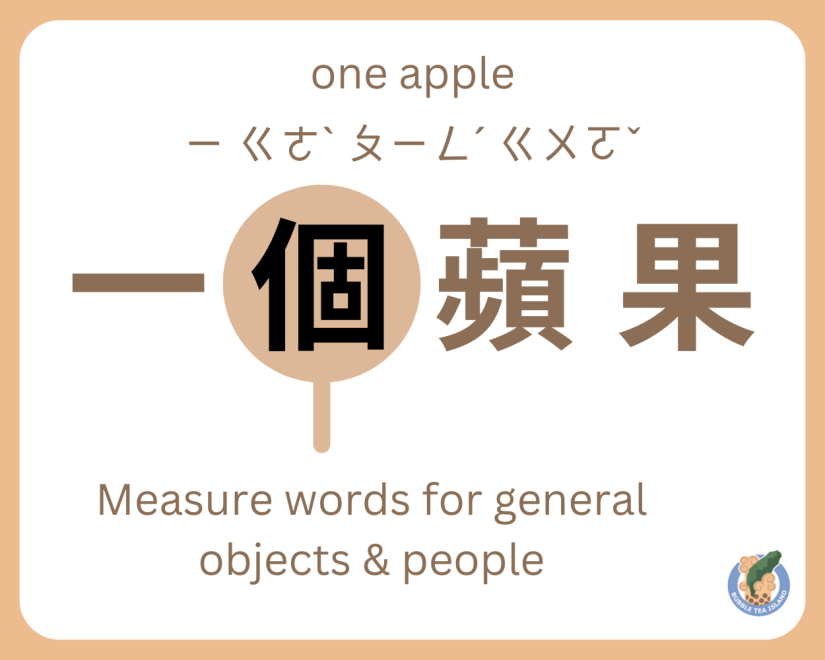
There are many different types of measure words in Chinese, and each one is used to count or quantify a specific category of nouns. Here are some examples of commonly used measure words:
| Chinese | Bopomofo | Pinyin | English |
|---|---|---|---|
| 個 | ㄍㄜˋ | gè | Used for general objects or people |
| 張 | ㄓㄤ | zhāng | Used for flat objects, such as paper, pictures, or maps |
| 本 | ㄅㄣˇ | běn | Used for bound objects, such as books, magazines, or notebooks |
| 隻 | ㄓ | zhī | Used for animals, such as cats or dogs |
| 頭 | ㄊㄡˊ | tóu | Used for large animals, such as horses or cows |
| 條 | ㄊㄧㄠˊ | tiáo | Used for long, thin objects, such as snakes, rivers, or pants |
Lucky and Unlucky Numbers
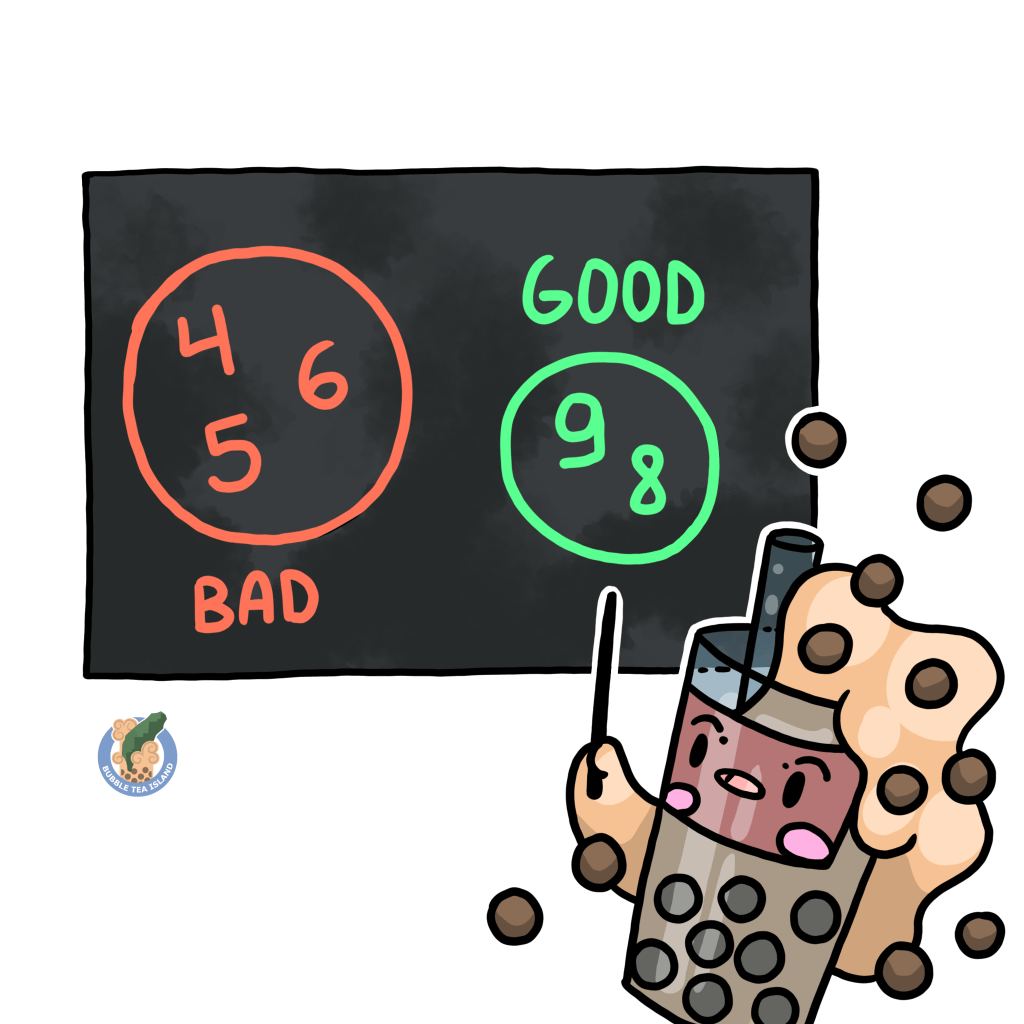
In Chinese culture, certain numbers are considered lucky or unlucky. The number 8 (八) is considered lucky because it sounds similar to the Chinese word for “prosperity” (發財 – ㄈㄚ ㄘㄞˊ). The number 4 (四) is considered unlucky because it sounds similar to the Chinese word for “death” (死 – ㄙˇ). As a result, many Chinese people avoid using the number 4 in phone numbers, addresses, and other important situations.
In addition to 8 being considered lucky due to its similarity to “prosperity,” the number 9 (九) is also considered lucky because it sounds similar to the Chinese word for “longevity” (長壽 – ㄔㄤˊ ㄕㄡˋ). This number is often associated with happiness and is often used in weddings and other joyous occasions.
On the other hand, the number 5 (五) is considered unlucky because it sounds similar to the Chinese word for “nothing” (無 – ㄨˊ). Additionally, the number 6 (六) is considered unlucky because it sounds similar to the Chinese word for “流 – ㄌㄧㄡˊ,” which means “to flow away” or “to slip away.” For this reason, it is often avoided in important situations, such as choosing wedding dates or house numbers.
Chinese Hand Gestures to Count
Knowing the hand gestures for counting is very important, especially in noisy markets where hearing each other can be difficult. You can simply point at what you want and use hand gestures to indicate how many of it you want.
The numbers from one to five are quite simple, as they are the same as in most Western countries.
- One: Simply raise your index finger.
- Two: Raise your index finger and middle finger.
- Three: Raise your index finger, middle finger, and ring finger.
- Four: Raise all fingers except the thumb.
- Five: Raise all fingers.
Counting from 6 to 10 becomes a bit more complicated, as they not only differ greatly from what we are used to but also because there are variations between Taiwan and China, and even variations within China itself.
In China:
- Six: The little finger and thumb are extended; the other fingers are closed.
- Seven: The fingertips are all touching, pointed upwards, or just the fingertips of the thumb and first two fingers.
- Eight: The thumb and index finger make an “L” and the other fingers are closed.
- Nine: The index finger makes a hook and the other fingers are closed.
- Ten: The fist is closed with the palm facing the signer or the arms are raised and the index fingers of both hands are crossed in a “十” (making the Chinese number ten).
In Taiwan:
The gestures for the number 7, 8 and 9 are different in Taiwan.
- Six: Same as in China.
- Seven: The index finger points down with the thumb extended, mimicking the shape of a “7” (Very similar to 8 in China).
- Eight: The thumb, index finger, and middle finger are extended.
- Nine: Four of the five digits of the hand are extended, the exception being the little finger.
- Ten: Same as in China.
Note that numbers seven and eight are commonly used this way as well in Southern China.
In conclusion, understanding numbers is an important part of learning any language, including Chinese. While the Chinese number system may seem daunting at first, it is actually quite easy to learn and use. By memorizing the basic number characters and practicing pronunciation, you can quickly become proficient in counting and using numbers in everyday situations. Additionally, learning number-related vocabulary can help you better communicate about numbers in Chinese. Finally, being aware of lucky and unlucky numbers can help you avoid cultural faux pas when communicating with Chinese speakers.

Join our Substack “Mandarin Zest“, where we regularly share intermediate to advanced Chinese learning content. Make sure to subscribe!
 Bubble Tea Island