
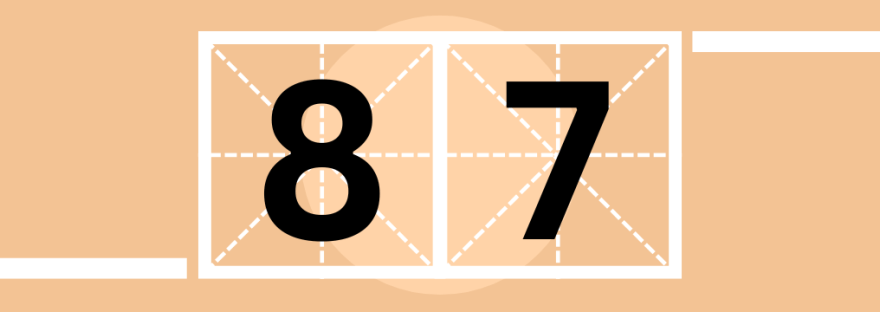
Mandarin Chinese is a language full of rich nuances and creative wordplay, often shaped by homophones, slang, and cultural references. One quirky example of this is the number 87, which takes on a completely different meaning in Taiwanese Mandarin.
If you’ve come across expressions like “87 分, 不能再高” (87 points, that’s the highest score I can give), you might wonder why this specific number carries an edge of humor or insult. Here’s everything you need to know about the deeper meaning of 87 in Mandarin Chinese.
The Hidden Meaning of 87 in Mandarin
In Taiwanese Mandarin, 87 (ㄅㄚ ㄑㄧ- bā qī) sounds very similar to the slang term 白癡 (ㄅㄞˊ ㄔ – bái chī), which means “idiot” or “fool.” This phonetic similarity is the key to its usage as a playful, and sometimes sarcastic, way to call someone an idiot.
For example:
- When someone makes an obvious mistake, you might hear a friend exclaim, “你好87喔!” (You’re such an idiot!).
It’s worth noting that while “87” is often meant humorously, it can come across as rude depending on the context and tone.

“87 Points, That’s the Highest I Can Give”
A more layered way 87 is used in Taiwanese culture is in the phrase “87 分, 不能再高”. On the surface, it appears to be a generous score—after all, 87 out of 100 is quite good. But here’s where the insult lies: by giving “87 points,” you’re slyly implying the person is an idiot.
This clever jab has found its way into Taiwanese humor, especially when evaluating something or someone you find unimpressive.
Example in Context:
Imagine a politician conducting an online survey to assess their performance. If you wanted to mock them subtly, you might respond with, “I give you 87 points, and that’s the highest I can give.” While it seems like a positive score, the underlying message is that they’re not as competent as they might think!
Why Numbers Play Such a Big Role in Mandarin Slang
Mandarin Chinese is filled with puns and wordplay because the language is rich in homophones. Numbers, in particular, are a popular tool for creating slang terms:
- 520 (wǔ èr líng) sounds like 我愛你 (wǒ ài nǐ), meaning “I love you.”
- 88 (bā bā) is often used as “bye-bye” due to its phonetic similarity.
- 233 is Internet slang for laughing, derived from emojis on Chinese forums.
In this context, 87’s transformation into a playful insult is a natural extension of the language’s creativity.
How to Use 87 in Conversation
If you want to sprinkle some Taiwanese humor into your Mandarin, here are a few ways to use 87 appropriately:
- As a Joke Among Friends:
- “你這麼87喔!” (You’re so silly/idiotic!)
- Use this when someone makes a funny mistake or acts a bit clueless.
- For Subtle Criticism:
- “我給他87分,不能再高。” (I give him 87 points, and that’s the highest I can give.)
- Perfect for situations where you want to mock someone lightly without being too direct.
- In Memes or Internet Comments:
- 87 is a favorite among netizens in Taiwan, so you’ll often see it pop up in sarcastic memes or humorous posts.
Final Thoughts
The number 87 in Mandarin Chinese showcases the creativity and humor embedded in the language, especially in Taiwanese culture. While it might just look like a number to outsiders, its phonetic similarity to “idiot” has turned it into a clever insult and a key part of modern slang.
Next time you hear someone say “87 分, 不能再高,” remember that they might not be giving as much praise as it seems! Use it with caution, and always keep the tone light-hearted to avoid misunderstandings.
Want to explore more unique Mandarin slang and cultural nuances? Subscribe to our newsletter for fresh insights every week!
Join our Substack “Mandarin Zest“, where we regularly share intermediate to advanced Chinese learning content. Make sure to subscribe!
 Bubble Tea Island
87 is originally adopted from Taiwanese language not Mandarin Chinese, but it means the same thing in Mandarin Chinese.
LikeLike
Oh interesting! I didn’t know! Do you know by any chance what’s proper writing of the word in Taiwanese? I cannot find it in the MOE Dictionary (https://www.moedict.tw/).
LikeLike
You could learn how to speak and write in the same time, because it’s easier to write correct Taiwanese words in romanization system. After you are familiar with some characters, you could mix both writings. Ministry of Education announced 閩南語拼音as official guidelines; however, most foreigners are learning Pehoeji writing. Here are few sites that are available for everyone.
https://tailo.moe.edu.tw/prac1.html
LikeLike
I use 臺語注音符號 for Taiwanese (https://bubbleteaisland.com/2023/01/30/learn-taiwanese-bopomo-in-5-minutes/). I don’t like using the Latin alphabet to learn Asian languages.
My question was more; how do you write 87 in Taiwanese as the word 白癡 doesn’t exist in Hokkien – Like which are the proper characters?
LikeLike
Bopomo is not perfect for spelling the Taiwanese language, because it misses some of the pronunciation.
The correct character for 87 is 白癡, but in Taiwanese spelling, it should be pe̍h-tshi.
LikeLike
Not 漢語注音符號, but 臺語注音符號. It is a much better system for Taiwanese pronunciation than romanization. The latin alphabet is not capable of capting all the Taiwanese Hokkien sounds.
LikeLike